Following a Song (Part 1)
Part one of a series on how music earns. Every song is at least two copyrights, paid separately, often to different people. Here is the chain from a song being written to a payment landing, and the economics of streaming, distribution, and sync along the way.
Lincoln Savage
18 min read
Part one: how a song earns, and who collects what along the way
Every song you hear is, in law, at least two different things at once. It is owned and paid for separately, and often the two halves are owned by different people. Most working artists know this only vaguely, and most of the time that is by design. The machinery that turns a song being listened to into money arriving in someone's account has been built up over a hundred years, layer on layer, contract on contract, society on society, into a system that even its own auditors call opaque.
Some of that complexity is unavoidable. Music has always been a layered set of rights. A song is a composition, and a recording, and a performance, and at any given moment three different organisations might be collecting money on behalf of three different rightsholders for three different uses of it. The complexity itself is real.
But complexity that benefits the people inside it, and that the people outside it cannot inspect, is not a neutral fact. It is the place where the system's failures live, and it is the place where most of an artist's potential income quietly disappears.
This is the first piece in a short series that tries to lay the chain out plainly: how a song earns, who collects what and on whose behalf, and where the gaps are. Part one walks the chain from a song being written to a payment landing, and explains the economics of streaming, distribution, and sync along the way. A later part will look at what an artist can and cannot see inside that chain, the data-access fights now underway, and the regulators starting to ask the same questions, including the Australian Competition and Consumer Commission's current review of APRA AMCOS's licensing arrangements.
This piece does not take a position on what the system should look like. It describes what it looks like now, and where the holes are, and hopefully helps make sense of it all. The article is long, because the system is a maze and a maze does not get clearer by being summarised. Read in order, or jump to the section you need.
The basic split
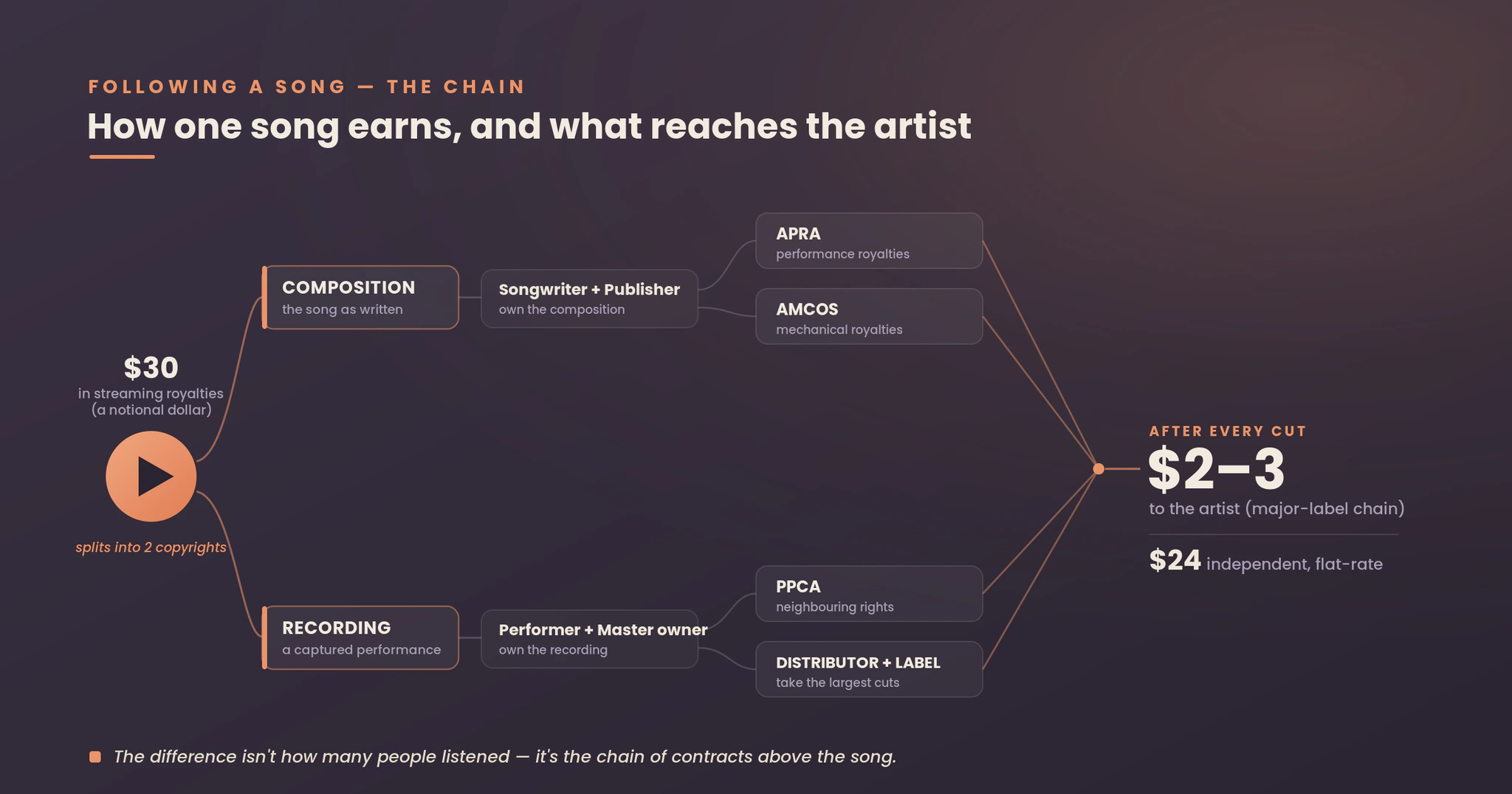
Every song generates two separate copyrights. The composition, which is the song itself: the melody, the chords, the lyrics, the structure as written. And the recording, which is a particular performance of the composition committed to tape, or to digital, or to vinyl. These two copyrights are owned, licensed, and paid separately. They are also, in many cases, owned by different people.
If you wrote and recorded a song alone in your bedroom, you own both. As soon as you brought in a producer, an engineer, a co-writer, a session musician, or a label, you began carving the two copyrights up between yourself and other parties. Most of the disputes and most of the missing royalties in the music industry happen at the seams between these splits. Knowing the split exists, and how it sits across the people who worked on the record, is the most useful single fact a working artist can have.
Every time the recorded version of your song is used somewhere in the world, it generates revenue under as many as three different categories.
There are mechanical rights. These are paid for the act of reproducing the composition. Every download, every CD pressed, every vinyl cut. Streams also generate a mechanical component, splitting the per-stream payout between the performance side and the mechanical side. Mechanical royalties are owed to the songwriter and the publisher: the people who own the composition.
There are performance rights. These are paid when the composition is performed publicly. Every radio play, every sync placement on a TV show, every streaming play, every live performance in a venue licensed for music. Performance royalties are also owed to the songwriter and the publisher, but they are collected through a different organisation than mechanicals. In Australia, that is APRA. In the UK, PRS for Music. In the US, ASCAP, BMI, SESAC, or GMR depending on which one the songwriter is signed to.
And then there are neighbouring rights, which many artists do not realise exist. Neighbouring rights are paid to the performer and the master rights holder for the public performance of the recording, separately from the underlying composition. When a record gets played on the radio, the songwriter side gets a performance royalty, and the recording side gets a neighbouring rights payment. They are two different organisations, two different statements, two different audit trails. In Australia, neighbouring rights are collected by the PPCA. In the UK, by PPL. In the US, for digital broadcasts only, by SoundExchange. In most other countries, separate societies again.
This is the architecture under everything else this piece will cover. A composition has a publisher and a songwriter. A recording has a performer and a master rights holder. Each pair has a collection society for performance use, a collection society for mechanical use, and a collection society for neighbouring rights. That is a minimum of six organisations involved in a single song's earning, every time it gets used. Most working artists know two of those six exist. The rest of the chain operates without their direct visibility.
The creation chain
A song does not arrive at a streaming service with its rights pre-arranged. It arrives at the end of a chain of decisions, contracts, splits, and registrations, most of which happen quietly during the recording process and almost none of which the average listener will ever see. Knowing the chain matters because every link of it is where money either flows correctly or, more often, does not.
Start at the writing.
Many modern songs have multiple writers. A producer who built the beat. A topliner who wrote the melody. A vocalist who wrote the lyrics. A featured artist whose verse came in late. Each of them, by default, is a co-author of the composition, and each of them owns a share of it. Those shares are negotiated, sometimes through written split sheets signed in the studio, more often in the gap between "we should write this down" and "we'll sort it out later." A song that becomes successful with the splits unwritten generates a problem that gets harder to solve every year it earns money.
Each songwriter then decides what to do with their share. Self-published writers register their share directly with their performance rights organisation and a mechanical-rights body. Most working writers eventually sign with a publisher: a company that handles the registration, the chasing, the licensing, and the auditing in exchange for a percentage of the income, typically 20 to 50 per cent of publishing income depending on the deal. The publisher's share is sometimes called the "publisher's share" of the composition; the writer keeps the rest, often called the "writer's share." The two move through different parts of the collection chain even though they originate from the same registration.
Now turn to the recording side.
The recording is a separate copyright. It belongs, by default, to whoever paid for the session: the artist if they self-funded, the label if they signed a deal. A standard major-label recording contract grants the label the master copyright outright. A typical "label services" deal lets the artist retain the master in exchange for a higher cut to the label. Independent artists who record on their own are the master rights holders by default.
The performers on the recording, separately again, have neighbouring rights. A guest vocalist who sang on the record is paid neighbouring rights when it gets played publicly, even if she does not own a share of either the master or the composition. These payments flow through a different society again: PPCA in Australia, PPL in the UK, SoundExchange in the US for digital broadcasts only. Most session performers do not register and never receive these payments. The money sits in suspense accounts until it is forfeited or claimed.
The recording, with its master rights and its neighbouring rights, then needs to get distributed. Either through a major label that owns the master and handles distribution as part of the deal, or through an independent distributor, or through both: a label-services deal where the label owns or controls some rights but the artist retains others.
Distributors do two things. They get the recording to streaming services and digital storefronts, and they collect the money those services pay back. That sounds simple. It is not. Distributors take a fee for the work, and the fee structure varies wildly. Flat-rate distributors charge a yearly subscription and keep none of the streaming revenue. Commission distributors take a percentage of the income, often around 9 per cent, sometimes for the life of the catalogue. Higher-touch distributors take around 15 per cent in exchange for label-services support. Pure label-services agreements can run anywhere from 30 to 50 per cent but bring marketing, sync teams, and other promotional infrastructure.
The distributor passes the money to the master rights holder, which is sometimes the artist, sometimes a label, sometimes both. If a label is in the chain, the label takes its cut: typically 75 to 85 per cent of master royalties on a traditional major-label deal, with the artist keeping the remaining 15 to 25 per cent. Newer artist-friendly deals can land closer to 60/40 or 50/50, and any deal involving recoupable advances comes with the artist's share withheld until the advance is paid back. After all of that, the artist's manager takes around 15 per cent of what reaches the artist, and the lawyer takes a cut of any deal they negotiated.
A track on a traditional major-label deal that earns 30 US dollars in streaming royalties can, in practice, leave around 2 to 3 dollars in the artist's bank account by the time it works through this chain. An independent artist using a flat-rate distributor with no label, no manager, and no lawyer, and who has properly registered both their composition and their recording, can keep substantially more, sometimes 20 dollars or more of that same notional amount after distributor fees. The variable that determines which version applies is not how many people listened. It is how the chain of contracts above the song is structured.
How streaming actually pays
When you press play on a song on a major streaming service, that play does not generate a fixed payment to the artist. It generates a fraction of a payment, and the size of that fraction is determined by a pool calculation that runs across the entire platform every month. This is the part of the streaming economy that surprises most artists when they learn it.
The standard model is called pro-rata, and every major streaming service uses it as their default. Each month, the platform takes its total revenue from all subscribers and all advertising, sets aside its own cut (around 30 per cent), and pools the rest as rights-holder revenue for that month. That pool is then distributed to all rights holders proportionally to their share of the platform's total streams that month.
The maths has a counterintuitive consequence. If you stream one of your favourite independent artists every day for a month, and the listener next to you streams nothing but the biggest pop star in the world, your subscription dollars do not flow to the independent artist. They flow into the same pool that covers the pop star's streams, and the pop star's share of total platform streams is many orders of magnitude larger. Your subscription is functionally a vote in favour of whichever artist commands the most plays globally that month, regardless of what you actually listened to.
The alternative, user-centric, divides each subscriber's monthly fee only between the artists that subscriber streamed. SoundCloud has run a version of this model for independent artists since 2021, and reports indie artists earning more under it; independent research has found a majority of artists on the system better off than under pro-rata. The largest services have not adopted it. Deezer, with Universal, developed a hybrid they call "artist-centric" that caps each user's contribution to any single artist and weights "professional" artists, but it is not the same as user-centric, and the major labels broadly back it instead.
Inside the pro-rata model, the platforms have built a series of additional rules that further reshape who gets paid and who does not.
The most consequential is the streaming threshold. Since 2024, Spotify requires a track to accumulate at least 1,000 plays in a rolling 12-month window before it earns recording royalties at all. Below that threshold, the track stays on the platform and the streams keep counting publicly, but no royalty is paid. Spotify has said the great majority of tracks on the platform sit below the threshold while accounting for a tiny fraction of total streams, and that the royalties which would have gone to those tracks are redistributed to tracks above the threshold. Supporters describe this as cleaning up negligible micro-payments; critics describe it as redirecting money from the smallest artists to the largest. Both are descriptions of the same money, with different lenses on who it should have gone to.
The threshold sits alongside a minimum-listen requirement for functional and noise content to qualify, and a per-track penalty charged to labels and distributors for tracks flagged for high artificial-streaming activity. The penalty is meant to deter bot streaming, which is real and rampant: platforms remove tens of millions of tracks for fraud and spam each year, and a 2024 federal indictment in the United States described a single operator who used AI-generated tracks and streaming bots to extract more than 10 million dollars from the major services. But the same penalty can also catch legitimate artists with viral spikes or playlist activity that an algorithm flags as suspicious, and distributors typically pass the penalty on to the artist regardless of cause.
Then there is Discovery Mode, where an artist or label can opt selected tracks into a platform's radio and autoplay placement in exchange for a commission on the royalties from any qualifying streams. The Recording Academy, the American Association of Independent Music, and a number of working artists have called the structure digital payola. The platform's framing is that participation is opt-in and that the per-stream rate is not reduced. Both descriptions are accurate. The disagreement is over what to call it.
What an artist earns per stream, after all of these layers, varies by service and varies considerably by listener territory and subscription tier. The figures below are blended averages reported by the music-industry trade press through 2025. They are not contractual rates, and any artist quoting them as fixed rates is misreading them. But the orders of magnitude are stable across reporting cycles.
From song creation through to listeners
The picture these numbers sketch is the same one working artists have been describing for years. A track with 100,000 streams a month, after the rights-holder side pays its labels and distributors and performance rights organisations and publishers, is, for most artists, not a working income.
What the artist actually keeps
The chain above runs from songwriting through publishing, recording, and distribution. This section pulls one specific knot into focus, because it is the knot working artists have the most direct control over: which distributor they use, and what that distributor takes.
Most independent artists in 2026 sit on one of a small set of distributors. The flat-rate model charges a yearly subscription, often in the 15 to 50 dollar range depending on tier, and keeps none of the streaming revenue. The commission model charges a small one-off fee per release and then takes a percentage of royalties, often around 9 per cent, in exchange for keeping the catalogue up indefinitely. The higher-touch and label-services models take 15 per cent or more in exchange for sync teams, marketing, and catalogue management. Freemium and negotiated-split models sit in between.
The fee structure changes the maths at scale. A flat-rate distributor is more efficient at high volume; a commission distributor is more efficient at low volume because the up-front cost is a one-off. An artist generating 10,000 dollars a year in streaming royalties pays a flat-rate distributor a fixed annual fee that works out to a fraction of a per cent, and pays a 9-per-cent commission distributor 900 dollars. At 1,000 dollars a year the absolute numbers shrink, but the commission rate stays the same. The first question is simply whether the artist's expected catalogue earnings justify a flat fee or a percentage.
The second question is what the distributor adds beyond moving files to platforms. A label-services tier buys access to a sync team, marketing infrastructure, a catalogue-management portal, and support an independent artist working alone would otherwise need to assemble themselves. Pure self-distribution is cheap because it is a thin layer: the artist absorbs the work the distributor would otherwise be doing.
The third question is what the distributor does with the revenue once it arrives, and this is where much of the recent complaint about distribution surfaces. Distributors collect from the streaming services in the artist's name, hold the money in suspense accounts, batch the conversions across multiple platforms and currencies, deduct their fees, and disburse to the artist. The reporting an artist receives can be granular or generic depending on the distributor, and the reconciliation between platform statements and distributor statements can be straightforward or impenetrable. The visibility an artist has into that step is the subject of part two of this series.
A working artist's actual take-home from a streaming dollar depends on which model they operate under. On a traditional major-label deal, after recoupment and the standard split running in the label's favour, an artist keeps roughly 15 to 25 per cent of master royalties, and after manager and lawyer fees commonly takes home around 2 to 3 dollars from a notional 30 in streaming royalties. On a flat-rate independent setup with no label, no manager, and no lawyer, that same 30 dollars can leave 24 or more in the artist's account. The variable that determines which version applies is not how many people listened. It is how the chain of contracts above the song is structured.
Sync as a counter-example
The streaming side of the business operates on pool calculations and per-stream rates. The sync side, where music is licensed for use in television, film, advertising, and games, operates on individual negotiated fees. The difference is worth registering, because sync is one of the few corners of the music industry where the artist or their representative knows in advance what a single use of their work will pay.
Independent sync placements in 2025 sit across a wide range. A song in an independent film typically pays 500 to 5,000 dollars. A placement on a smaller cable or streaming show pays 1,000 to 10,000. A featured placement on a major streaming-platform original series can pay several thousand to forty thousand or more, depending on the show's profile and the song's prominence in the scene. Local commercials pay 1,000 to 5,000. National commercials in large markets run 10,000 to 250,000 or more, with major brand campaigns routinely six figures. Game placements vary widely. Micro-sync placements on short-form video platforms pay anywhere from a few dollars to a few hundred per use, with low ceilings but high volume.
The sync market has changed shape in two ways relevant to independent artists. First, catalogue-matching marketplaces let independent artists upload their work and have it auto-matched against active briefs from music supervisors, lowering the barrier to pitching, while boutique pitchers continue to operate at the higher end with human supervisors and deeper relationships. Second, the major short-form-video platforms have moved to blanket-license user uploads of copyrighted music through direct deals with rights holders, paying through pool-style mechanisms rather than per-placement fees, which has made the line between "sync" and "streaming" genuinely ambiguous on those platforms.
For the working artist, sync remains one of the few music-industry revenue streams where the structural transparency runs in the artist's favour. A sync agreement is a written contract for a defined use at a specified fee. The artist or publisher can audit it, and the payment arrives on a stated timetable. None of that is true of streaming pool distributions, and the contrast is not coincidental: sync is where the buyer is a specific party negotiating with a specific rights holder, while the rest of the music industry is increasingly intermediated through pools, samples, and proxies.
Coming in part two
Part one has laid out the chain: two copyrights, a minimum of six collecting organisations, a pool calculation at the streaming layer, a distributor layer the artist mostly controls, and a sync layer that behaves differently from everything else.
The pattern that runs through all of it is this: at every layer, an artist receives a number and is asked to trust it. Part two follows that thread. It looks at what an artist can actually see inside the chain and what they cannot, the privacy-law mechanisms some artists are now using to pry their own data loose, the disputes that have surfaced as a result, and the regulators, the ACCC's current review of APRA AMCOS among them, who are starting to ask whether the trust is warranted.
The Tape's editorial position, stated up front, is that working artists are entitled to better information about the economy they work inside. We will keep covering this, including the parts of it that are uncomfortable for the institutions writing the cheques, and including where it touches Distrosub.
Comments (0)